Friday, May 9, 2014

REVERSE PHOTOSHOPPING


A few months ago I had come across an article via Facebook that took me by complete shock. The term I learned in this article was called "Reverse PhotoShopping".  Essentially this phrase means that retouching photos is not used to make models look thinner, but is now being used to make models look fuller and healthier; no ribs or bones protruding from their skin.

This took a minute for me to process that it was actually a real thing that was happening. In our society, there is so much pressure for models to look extremely slim; collar bones showing, hip bones showing, and the infamous thigh gap. The models are trying to hard to fit this look that some are making themselves sick in order to achieve it.  Unfortunately, the editors are able to cover up the ill-side of models by now plumping the models back up to a healthier, yet still slim figure via Photoshop.

The former editors of Cosmo, Healthy Magazine, Vogue, and British Vogue have all admitted to having to photoshop models to make them look not so thin. These are fashion magazines that have a huge influence over the female population, specifically how we as women are supposed to replicate. As I have previously written about, media has a large impact on female's perceptions of their own body, and it can be correlated with a higher percentage of eating disorders. In a recent study I read:
"A meta-analysis of 25 studies involving female subjects, examined the effect of exposure to media images of the slender body ideal. Body image was significantly more negative after viewing thin media images than after viewing images of either average size models, plus size models or inanimate objects. "
-essentially this means that girls feel worse about their own bodies after seeing the bodies of the models in magazines. We are buying the magazines that are making us feel inadequate. I admit to buy Cosmo, Vogue, etc, unknowing that even if I am aware of how the media affects me, I am still buying into the falseness of the images.  It is hard to continuously remind yourself when you are looking at a beautiful editorial of Gisele in Vogue to remind yourself that, "yes she is gorgeous, but she is photoshopped to further enhance her 'beauty' (which can be defined as clear skin or a small wasit) and it is almost impossible to look like that without the help of photoshop". That is not an affirmation I want or will remember to tell myself each time i pick up one of these magazine. The intense use of photoshopping needs to be regulated and its heartbreaking that something this emotionally damaging has not yet been banned.
THANK GOODNESS SOMEONE IS DOING SOMETHING ABOUT IT! I was so happy as I was researching articles for this blog that two congresswomen were in the midst of trying to regulate photoshopping. Republican Rep. Ileana Ros-Lehtinen and Democratic Rep. Lois Capps have co-sponsored a bill entitled H.R. 4341: Truth in Advertising Act of 2014, which calls for photoshop regulation in media and advertising. Essentially this bill will try and create guidelines for photoshopping, so as it does not continue to promote unrealistic body images. YAY! I will continue to follow this as I think its fantastic. (SIDE NOTE: this is the link that talks about the bill, you can actually voice your opinion to your local congress member about your support so hopefully it can get passed! https://www.govtrack.us/congress/bills/113/hr4341/text)
However, as I was writing this article is dawned on me, I dont have to wait for a bill to pass to regulate photoshop. As a model, I have signed numerous contracts allowing others to photoshop me for use in their editorials. What most independent models such as myself dont do, is create their own contracts. Usually they are used to protect their own rights of publication and such. What I have decided to do from today forward, is to have my own contract for those who i work with stating that they are unable to use photoshop to manipulate my size, shape, or proportions. If they are unwilling to sign it, I will be unwilling to work with them. I would love for this idea to catch on among other models in my community, and possibly further than that. I will be developing a contract within the next week or so, and if you want a copy to use for your own modeling PLEASE EMAIL ME! I think that waiting for major corporations such as Vogue and Cosmo to decide to start regulating photoshopping is going to be a LONG battle. I think starting with the models is a better way to fix the problem sooner. Just imagine is Gisele or Kate Upton prevented the use of photoshopping to manipulate their size, how much support they would get from others. This may be a pipe dream, but I like to dream big :)

here are some of the links to the articles I found my information on if you want to look further into this topic <3 you are all amazing and thanks again for reading

http://jezebel.com/congresswomen-introduce-bill-to-regulate-overzealous-ph-1564436575
http://www.ncbi.nlm.nih.gov/pmc/articles/PMC2792687/
https://www.govtrack.us/congress/bills/113/hr4341/text

Monday, March 17, 2014

Blame it on Barbie?

http://m.refinery29.com/2014/02/61795/barbie-designers-body-image-issue?utm_source=facebook.com&utm_medium=post

I read an interesting article last week on Barbie's potential influence on body image (post above) on children as well as adults, and as growing up playing with barbies I was curious to see, is Barbie really to Blame?

The argument of the article is: do the unrealistic proportions of Barbie affect the mental health of the child? As we have all heard, if Barbie was real, her proportions would have her walking on all fours because she would be so top heavy.  Galia Slayen, a former student at Hamilton College, was the first to really show what Barbie would look like if she were real.
Barbie does lok ridiculous when we use her "real-life" proportions (everything besides her head). Definitely not as attractive as when she is in her normal toy form. As adults, we are aware that she is not how people actually look and as adults we are aware that Barbie is only a toy, but as children, do they know what we as adults know? Im leaning towards no. The article made a good point that at the same age they are playing with Barbies is the same age they still believe in Santa Claus. They dont see Barbie's "flaws" the same as adults see them. Barbie is whatever the child makes them out to be, one day she is playing mommy to Skipper, one day she is rescuing puppies as a veterinarian, one day she is your buddy in the bath tub, and one day she is your very best friend. Barbie is never casted as the blonde bombshell or the hot girl at the club. Barbie seems to just be the vessel of childhood imagination, not someone who dictates it. I find it hard to believe that Barbie can be responsible for childhood low-self esteem, low self-worth, poor body image, or promoting eating disorders. Not that I rule out Barbie has zero influence, but i find it to be minimal. What I think is more important is the people surrounding the child and how they foster a healthy image of how people should look, behave, and think. If  a child has parents or guardians that are promoting individuality, self-worth, and positive body image, they are going to be less likely to be influenced by the societal pressures of being Barbie. We as a society tend to find reasons to blame external uncontrollable factors for things that occur, instead of trying to focus on what we can do right now to make the situation better. I think this article is a perfect example of the struggle of who's to blame. 
As parents, guardians, brothers, sisters, FRIENDS etc we can have a great influence on the ideals of a child, regardless of what society is pressuring them to be. If we help to create a strong sense of self, the child is less likely to be influenced on what others have told them they need to be ( read this in one of my psych books, cant find the source, will post when i stumble upon it so for now take my word for it). We all have the power to positively or negatively reinforce someone, and compliments are always free, so we should use them more often. Although we cannot control all the outside influences on what society shows us to be ideal, we can help to influence others in our own way and it can be just if not more powerful. 
Thanks again for reading! 

Friday, July 26, 2013

Healthy=Great Butt...what?

I recently did a presentation in class about how the media influences eating disorders and body image.  It was probably one of the easiest projects I have done in grad school because picking out potential triggers and influences in the media in our western culture is extremely easy and accessible....

I went into the local grocery store and scanned the magazine rack for something that was a good example of western culture's ideal of how women are "supposed" to look. The magazine that caught my attention the most was Women's Health; ironic right? A magazine that is supposed to inform women about their health was going to be the perfect example of why western culture promotes a generally unrealistic yet idealized image of a woman.... anyways there is a lot to dissect so here is the cover i saw..

GREAT BUTT...WEIGH LESS..... this is what women's health should consist of?? hmm..

Lets first break this down by the messages this is sending to the general population of all ages as they are in the grocery aisle.

Toddlers: They might not be able to read, but they can see. Children at this age learn what is or what is not appropriate through modeling behaviors of others.  Those adults with children, I can assume that you have taken them to the grocery store with you and they have probably seen the magazines in the check out stand. What does the child see in this picture? A lady in her underwear and a small top smiling, she looks happy and seems to be enjoying herself.  Children may not understand that this might "just be for the magazine" or that its only ok to dress like this if your an adult.  All they see is a half naked woman on the cover of a magazine, looking happy to be there. What do you think this is telling your child? It could be sending numerous messages, but one that it could be sending is "this is what girls wear. i am wearing this and i am happy. this is what girls look like when they wear this".  Boys see this and girls see this. both are getting similar messages of how girls are supposed to look. This is how media can start to shape what is the "ideal women" even at such a young age.

Big Kids: These kids might not be able to read very well, but they know their words. As stated previously, the biggest words on the front cover are "Women's Health" and "Great Butt".  Health is being associated with having a great butt. Sounds ridiculous, right?.  Children are looking at this magazine and seeing something that is supposed to educate them on their health, however in this case health means to great butt and to weigh less.  Something else to point out is, what does weigh less mean? Weigh less than what? It doesn't say, all it says is to weigh less.  Thinness is valued greatly in western culture, so much that it doesn't seem to matter what size someone is, just that they have to be thinner to be ideal.  You would think a magazine that promotes health should read "Learn how to maintain a healthy weight" or "Find out your healthy BMI range"...but it doesn't, it just says that for Women's Health, they should just weigh less.  Once again, there can be a lot of different messages taken from this cover, but the potential that a kid can take this magazine and connect being healthy to having a great butt is the not the appropriate message to be sending. 

ADULTS: US! the ones who think that they might not be as influenced by the media as these children are, the ones who believe they are no susceptible to peer pressure or social pressure, yet we are the ones who are buying it because the title says "WEIGH LESS...GREAT BUTT...FLAT BELLY IN LESS THAN 15 MINUTEs". Magazines pay lots of money to find out what consumers are attracted to and what makes them more inclined to purchase their magazine, so having those titles on the front cover is not by chance, its by what is known to sell.  and we purchase these magazines because we have been taught over the years that to be thin is ideal, that we must "weigh less" than we do to feel better, that flat abs are going to get us a better life or a cuter boyfriend and that "mind blowing morning sex" should be accompanied by a "great butt". It's a little crazy if you think about it.

but is this what we truly believe? it can have some truth to how we feel, this is what keeps plastic surgeons in business, tucking, sucking, and lifting; it is a multi million dollar practice.  People want to look better than they do, because they heard someone say they need a straighter nose, they need bigger boobs, and they need a smaller waist in order to feel better about themselves.  Don't get me wrong, working out and eating well changes the shape of our bodies and makes us stronger and we might enjoy the way we look now opposed to how we looked before we started going to crossfit or hot yoga or whatever you do to keep in shape, but making sure your happiness with yourself is not contingent on how many classes you do or don't attend is important It is important because the image of our bodies should not shave such a strong influence about how we view ourselves.  We are smart, we are courageous, we are independent, we are brave, we are creative, we are loving, we are loveable, we are so many more important things than the message our body image sends.  Stay mindful of the messages that are out there, but more importantly be mindful of how those messages might affect you. They are so many people unhappy with their appearance due to these messages that have been sent to us our entire lives, so how can we overcome something that is almost engrained into our minds? I don't have the answer to that, but I can say what helps is acceptance. Accepting yourself for who you are right now, not last year, not after you do a 30 day bootcamp, but right now in the present.

 On a personal note, there was a time that I did not feel happy with how i looked, to the point that I was ridiculous enough to make a list of plastic surgeries I could have done (this was after that horrible show The Swan--if you don't know if google it). Basically I wanted to look "ideal", what society had said was "ideal". as i got older, through many different life experiences, it clicked for me.  I learned to love how i looked, regardless if i was 20 pounds heavier than i was in high school, or if my boobs weren't as big as my best friends, or if i didn't fit into a sample size as a model casting. I didnt let that determine how I felt about myself.  I have learned to just truly love how i look, and have seen how much happier I am because how much i DONT stress about it. 

so stop standing in front of the mirror, analyzing and critiquing all the things you don't like about yourself. stop changing your outfit 50 times before you leave the house because you don't feel it "looks ok". you look great. I stumbled upon a quote this week that is a good closing to this entry...

"Over the years I have learned that what is important in a dress is the woman who is wearing it."
— Yves Saint-Laurent

That's all for now. I hope you enjoyed reading this topic, one of my favorites so far. youre all so beautiful :) and thank you for reading!


Monday, June 24, 2013

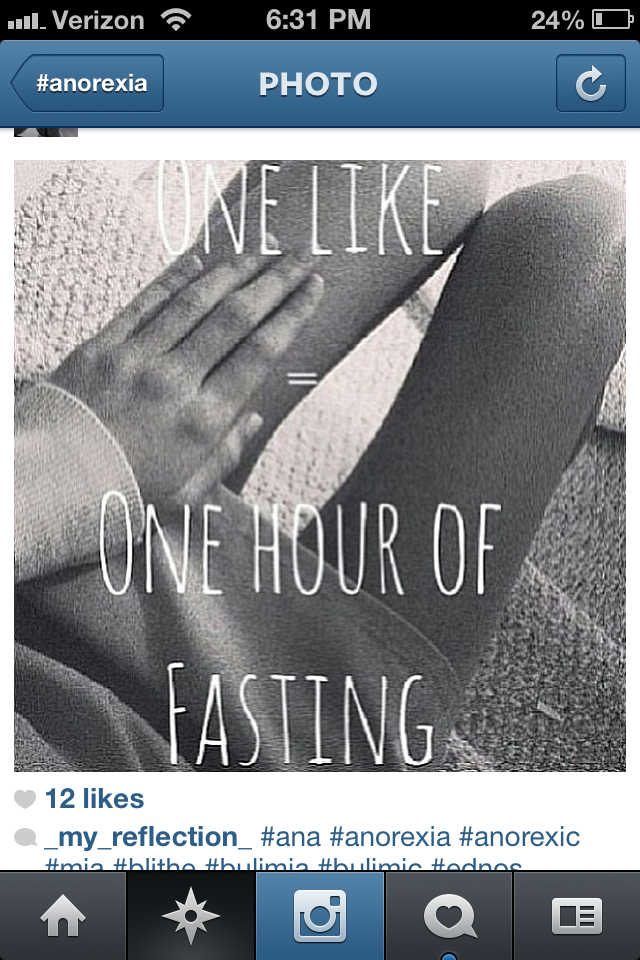
#anorexia #bulimia #instagramproblems

First let me share my excitement with everyone. I officially have an interview with Monte Nido NYC. for those of you who are not familiar with it, it is one of the most prestigious Eating Disorder Treatment Facilities in the nation. It has been my long term goal to become apart of Monte Nido so I am beyond crazy excited that I even have an interview with them.  They just opened Monte Nido NYC this month, so it will be great to be apart of a brand new branch. So please, send lots of positive vibes my way!

As you can see from the title, this post has to deal with my recent realization how instagram unknowingly allows hundreds and thousands of individuals to expose their eating disorder and even get supporters on their quest for thinness. Individuals are posting pictures of their emaciated bodies, asking for support and motivation to starve themselves, and helping to cheer them on when they skip dinner. It is really sad.


This was not the only picture of its kind.  People would post "one like=one day of not eating". It made me so angry and sad to see so many likes on someones picture and the comments cheering them on. As discussed in my previous posts, Thinspiration is a big part of the pro-ana world (pro anorexia).  People will use images of emaciated bodies as motivation to get thinner.  What Instagram does now is create an entire library of #thinspiration photos that eating disordered individuals are using as "goals". A main concern with so much #thinspiration available, is that it may also create not only unhealthy goals, but create competition between individuals, trying to be the thinnest, or trading ideas on how they got to a certain weight. This is dangerous because the wealth of information that is out there is not just how to recover, but how to maintain the eating disorder, which makes it a lot easier for an individual new to their disease to learn a lot of negative information very quickly. too quickly. 

#anorexia is another support group (both good and bad) that creates a community for those suffering with it.  a mixture of cries for help, pictures liek the one shown above, and quotes saying "nothing taste as good as thin feels". A lot of negative self-talk is most apparent. Its scary that there are so many people out there who are PRO-ANA (pro-anorexia), and they are able to group together to help support each other maintain their eating disorder instead of trying to overcome it. This type of behavior just reinforces their harmful behavior.  Especially since Instagram is not really monitored and parents and family might have a hard time accessing a loved ones IG page, there is no one to tell these Pro-Ana supporters to stop. It is also hard to tell if these Pro-ANA people are also suffering or if this is just another form of bullying; others taking advantage of someones vulnerable state and using it to take control and tell someone else not to eat or tell them that starving themselves is the right thing to do.  I think i spent about an hour just looking through different hashtags of all these pictures and it is hard not to feel heartbroken for these beautiful individuals.  As much as the internet has provided so many resources for eating disorder recovery and recovery groups, negative support is almost as prevalent.  Thank goodness there is a report button, and I think I spent half an hour just reporting...
I thought it was GREAT that instagram has this option. Not because I think reporting the picture will cause a great deal of change, but that might create one less "PRO-ANA" picture for those suffering from an eating disorder. Its sad how engulfed these individuals are by their eating disorder. Another great thing that Instagram has done is to put a warning notice anytime someone tries to search #bulimia #anorexia #eating disorders, etc

This made me so happy to know that there are others out there working towards the cause! The internet and social media is a great way to connect, but we never think people are connecting for these types of reasons.  #Suicide was really depressing as well, and you would think people would be using this to help them out of suicidal ideations, but there are people out there telling them to do follow thru with their suicide. I think in the future of social media, there needs to be more being done about bullying, abusive/offensive statements, and harassment on these sites. A task force or an entire department should be devoted to the cause.  Maybe that could be a prospective venture for me in the future, who knows. lol

What I want everyone to take away from this post, is to be aware of what is out there.  BE aware of what is going on in the world, and as for parents to realize what is out there.  Especially now teenagers have a lot more privacy when it comes to social networking, they can see a lot of things due to the internet and smart phones that was not accessible 10 years ago. This is one of them.  Especially if you have a teen with ED, monitoring all of this is important to make sure they are getting the RIGHT type of support, and not learning tricks of how to hide their eating disorder, or having people support their purging habits.  


to all those who are fighting through their eating disorder, keep fighting, you are strong enough, i believe in you. 
 Pro-Living > Pro-ANA 


Wednesday, May 8, 2013

Back on track!

I am back. Ive been wanting to be back for a long time now but school, work, internship, and my recent aspirations of modeling have taken up any and all time I have left. It has been over a year since I last wrote so I guess I should catch everyone up on my life. Last year I started my Master’s in Clinical Psychology with an Emphasis on Marriage and Family Therapy. My road to being a therapist, working with the eating disorder population, has started! I have had an amazing time so far at Pepperdine University, and I am learning so much, that I am already starting to feel like a real person! I have also started an internship as a “practicing therapist” at a substance abuse center in Compton, CA. It has been a very interesting experience and it feels so amazing being able to practice what I have been learning in school to help better other people’s lives. Its amazing. The reason I did not choose to get an internship at an ED (eating disorders) unit was because I had previous experience at Princeton University Medical Hospital working in the eating disorders unit (which was the most amazing experience), so I wanted to broaden my scope a bit and learn about a different population. I also currently work at Jenny Craig. When I first started working there about a year ago, I didn’t realize how good of a fit it would be for me, but over time I realized that disordered eating has a huge range of how it can affect a person. Overeating and Undereating both are huge issues in today’s society. What they both have in common is that as a “therapist” or “weight loss consultant”, you are trying to help your client obtain a new relationship with food and their body. Both have a hard time with overcoming the control food has had in their lives, and at Jenny Craig I get to help people to establish a new lifestyle towards food and themselves.
 My newest life venture, which is also the primary topic of this post is my new interest in Modeling. I am well aware the stigma of the modeling world and how that effects the media, publications, fashion, etc; and how that has affected society as a whole, especially the female population. Fashion and modeling place a great deal of emphasis towards thin women, and since that is the preference, we see it everywhere. My journey with the modeling world started last year when I auditioned for America’s Next Top Model. This is also where my idea of what type of model I wanted to be had started. During auditions I had met an awesome beautiful girl, who was tall like me, but was not the “stereotypical model”. She was lean, toned, healthy looking, and had curves to her, which most models on the catwalk are missing. As I looked around the group of females I was with, everyone was different shapes and sizes, and it was great to see we had all been in the later rounds of the competition. The girl I had described ended up finishing in the TOP 2! of that season on America’s Next Top Model, and for me that’s when it really dawned on me that the modeling world is starting to change. She did not have to fit the “mold” of a 5’10, 100lbs model, but she still succeeded. A lot of pressure and years of casting those type of models have limited to the runways to size 0s. It seems that the break of 2-4-6-8s are now making their way.
 I have done a lot of thinking about my modeling and how it would affect my career as a therapist working with people with eating disorders, knowing that the industry I am involving myself in has been used as “thinspiration” for thousands of girls who find themselves bent over the toilet because they are trying to strive for thinness. I have thought a lot about it, and realized that the model I want to become is to become a model that should be a inspiration, not a thinspiration. I want to be the model that eats healthy, not depriving herself to fit into a sample size. There is such an obsession with thinness in model world, and I want to enjoy this experience, not suffer through it. I also want to use my modeling to advocate more for ED and positive body image. Basically I want to use this opportunity to be not just a model, but a ROLE model. I know in that, I will succeed. ☺ I will try to update this blog more often with information about ED or just cool articles I think pertain. If you come across any articles feel free to share so I can post it as well. I am so excited to get restarted on this journey! Glad you can join me!

Wednesday, November 2, 2011

How much does a calorie weigh?

For those of you who have taken a science class, you know that a calorie is unit of energy and is not measures by weight necessarily...what I am referring to is how much weight people give to the importance of a calorie. How important is it to them? How much time do people spend looking at calories, counting calories, thinking about calories, and consuming/not consuming calories? You do not have to have an eating disorder for calories to be important. Athletes count calories to make sure they are consuming enough, Dieticians count calories because it is part of their job.etc. There are many reasons why people count calories and why they are important to them, but there are those out there that calories weigh too much of an importance in their life.
The appearance of calories are showing up everywhere. Companies are now putting the calorie content of a soda in big numbers right on the front of the can, just incase one didn’t bother to look at the nutritional facts on the back. Recently in California it became mandated to put nutritional facts on every menu item in a restaurant; which includes mcdonalds to applebees to starbucks. We all know that a Caramel Frap isn’t always the best choice, but now being unable to escape the realization that its 1500 calories might kill the enjoyment for some. I can understand the reason companies and the government choose to make nutritional facts more available. They want people, who normally aren’t aware, to become more educated about what and how much of it they are consuming. For people who did not pay attention before, now they have no choice anytime they go out to eat or get a soda out of the vending machine. Now that people are aware, they can choose to make the "healthier" decisions, maybe apples instead of French fries, or maybe a diet instead of a regular soda. (I put "healthier" in this case in quotations because not all foods that are low in calories are necessarily healthier). For some having the calories on the side of a can is very helpful, for others, it can be an unwelcome reminder of what they are about to put in their bodies
After seeing the good in the appearance of calories I couldn’t help but see what negative effects there can be. For a person with an eating disorder, calorie content can be very triggering. Seeing it now on everything can seem overwhelming for a person with disordered eating. Its in their face more than it has been, and ordering something from a restaurant might not just be a choice of what they are craving that day, but what has the lowest calorie content. During my internship we were instructed to divert sometimes attention if we could see they were focusing on the nutritional facts on their food items. Working in a ED unit, you notice the important that calories have on someone’s emotions. For someone used to counting calories and controlling what does or does not go into their body, finally introducing food that was before “off limits” due to its calorie content, can be very hard. This is a reason why we were instructed not to let them focus on the nutritional facts label. There are various other reasons for this rule, but I can see how someone in the situation might not enjoy the food item as much if they know the details, or it might even prevent the person from wanting it all together. Eventually, we want those recovering from ED to be able to look at calorie content and not have negative feelings towards them, but in the earlier phases of recovery, this might be impossible. So I can see how those with ED might have a problem with the appearance of caloric intake increasingly obvious on food products, but even those without ed can have problems with it as well.
American culture in the past 10 years or so has devoted so much attention on dieting, and most of these diets involve cutting calories. This creates the problem of what one wants and what one “should” have. Yes, we all want to make healthy food choices, but when we don’t, should we be subjected to the burden of knowing the piece of cheesecake we just consumed was half of our recommended daily calorie intake? I don’t think so.
Besides affecting the consumers of these products now, what about the younger generation. The "dietless" generation. The kids who have no idea what a calorie is or what a diet is, how are they going to react to this change? I was at a restaurant the other day, where, there is calorie content next to the menu item, and I overheard a small child asking the mom what the extra numbers were? The mother told the child that it was the amount of calories. The child proceeded to ask what that meant and the mom said something to the effect that its how many points food is; That good foods are less and bad foods are more. As you can probably predict I wanted to go and slap this woman with the menu lol i was not happy. The child is learning at such a young age what is “good” food and what is “bad” food. In my opinion, there is really no such thing. Everything is good in moderation, and as in life, its always important to have a good balance. It makes me concerned that I know this is not the first child to ask their mom the same question, and it worries me to know what other parents are saying as an answer to this question. Are we setting up the child for a healthy perspective of food, or are we setting them of to have a black/white mentality of what they should and should not eat. Should a child ever feel guilty for eating a certain type of food? Of course not. We should be very aware of how we teach out children about food, so they don’t have an unhealthy perspective later on.
Another very important question is, should an adult ever feel guilty for eating a certain type of food? The answer remains the same, no. But for some, that question might be a little harder to answer for some Remember, youre child is like a sponge and their behaviors will reflect youre own. Just because you are educating your child about food in a healthy manner, if you do not follow your own advise your child will see that. For example, youre at a birthday party and cake is being passed around. Your child grabs a piece of cake, but when the mother is offered a slice she makes a comment saying “no thanks, its too many calories, im trying to watch my figure”, the child will see and pay attention to that, and the next time they are offered a slice of cake, it wouldn’t be too surprising they could give the same response. Like they say, monkey see monkey do. And yes the parent might be trying to stay away from food that is high in calories, but it might not be best to demonstrate your concern about calories in front of your child. I am not saying that this child is going to have an eating disorder later in life, its just something that I would be more aware of as a parent who is trying to teach the child to have a positive view of food.
Anyways, going back to my main subject of the more prominent appearance of calories, I think it should have stayed the way it was. Knowledge is power, but I think in this case it is important to look at the cons and not just the pros. Instead of having the calorie content on the can, I think the government should instead use those efforts to teach kids more about things such as the food pyramid. Teach kids the power of whole grains or what foods can make their bones grow strong. I think if the government took this approach instead of just focusing on calories, I think the perspective of food will change and people will stop stressing about calories and instead embrace foods because of how they help your body to function. Just some food for thought… ;)


PS. sorry about my absence from the blog. trying to get back and pumping out more blogs :)

Monday, June 27, 2011

If You Can't Say Something Nice...

I recently started looking into this campaign called #LoveisLouder. Essentially it is an anti-bullying campaign that celebrities are trying to endorse that tries to spread the word to cut down on the negativity in our society. The concept is great, and there is definitely a lesson to be learned. In today's society, the social media has used its influence over society in both positive and negative ways. But, social media also has its downside. They will be the first to BASH someone if they do not follow their rules of 'what not to wear'. Watching E! "Fashion Police" or reading up the daily dose on Perez Hilton's Celebtriy Gossip Website, i am almost disgusted on how brutal they are towards celebrities and their appearances. They are rude, cruel, and straight forward. Usually using someone's fashion mishap or fashion ((faux pa?)) as an excuse for comedy or beratement. They will tear apart a celebrity on every aspect. Starting about how foul their dress is, then to how their body looks, whether they have gained 15 pounds in their thighs or look like skeletons. They continue on to whatever else they chose to attack on. Yea, we can say celebrities are used to this, that they should have to deal with it because its comes with the territory of being famous, but that type of thinking is counterproductive in our society. If we become maladaptive to hearing others getting bashed on their appearance, who is to say we wont think its ok to start doing the same to our friends, or even worse to ourselves?

I will admit to being one of those people. I was almost known for being the person to say something if someone walked by with a ridiculous outfit on. Not to them, but to my friends that would usually be some type of comedic statement but sometimes would just be unnecessarily mean. One year for lent I even gave up talking shit about strangers. Yea i know that is really bad to admit to but that what it was. But, actively working on not saying anything negative about a stranger really showed me that there was no reason to say anything negative about someone you don't know, or even the people you do know, especially when it came to appearances. You never know how much weight your words are worth. While working at the EDU at Princeton, there were so many cases that these girls could remember the first time someone made a comment about their weight/appearance and it happened to have triggered their eating disorder. some people have never been conscious of their body or weight, so when someone says something about it, it can cause people to panic and wonder if somehting is really wrong with their appearance. Not saying that everytime you comment on someones weight they are gunna have an ED, but that words are powerful things, and you should be careful what you do with them. My realization that talking negatively about someone doesn't benefit anyone. It goes to the saying, if you cant say anything nice, don't say anything at all. it does not make the person you're talking about feel better, and it doesn't really benefit you in anyway either. Its a lose lose. Saying something nice is, for the most part, a win win. Telling someone how great they look, will make them smile, and that smile will more than likely make you smile right back. One of the reasons that i want to become a therapist is that I want to make people feel and function better. In my professional life i want to be able to help people work through situations by positive speaking, and in my personal life I should be working on doing the same.

Talking negatively about others is not the only problem, because sometimes the most damaging comments come from ourselves. Its the The days when we tell ourselves we look fat, when we tell ourselves we aren't as attractive, when we don't think we deserve to feel better about ourselves. These comments I have heard from friends, family,and sometimes myself. It happens. We cannot all have good days. But I feel like in our society in particular, the pressure to look a certain way is intense. Thin is the main word that comes to mind. A majority of our society is trying to reach that certain level of thinness, and when we don't achieve it, we feel horrible about ourselves. I was watching Mean Girls other day and it was a good example of this trend. Lindsay Lohan's character Katy was watching The PLastics stand infront of the mirror and pick apart everything they felt was wrong with them. "my nail beds suck", "my shoulders are huge", "i have a huge forehead". and in the background Katy said, "i thought there was only fat and skinny". We have become so much more critical of ourselves, and we alll need to take a step back and accept what we got and what we were given. During my time at the EDU unit, I learned what affirmations were. The therapists would give their patient a phrase to repeat to themselves, maybe 5 times in the morning and 5 at night. They would be stuff that was so simple, "I am beautiful". The point was that at first, they would be saying it, not believing it, but over time they were not just saying it, but telling it to themselves as a fact. I think affirmations don't just need to be used in hospitals but in everyday life. How many times do you look at yourself in the mirror and say, "wow you're beautiful/smart/amazing/gorgous/etc". probably none. but think about it, if you were told everyday you were beautiful, wouldn't that make you smile? lol i think so. POSITIVE THOUGHTS PEOPLE!!

What I was trying to get out of this blog and my message to the masses was that we need to start being nicer as a society. Stop hating on people, stop making fun of others at their expense, and stop making unnecessary comments that does not better anyone. We should all be trying to bring each other up instead of bringing people down. There is a great quote from Marian Anderson, that pretty much sums it up, "As long as you keep a person down, some part of you has to be down there to hold him down, so it means you cannot soar as you otherwise might". Take it as a personal mission to try and eliminate negative talk out of your life. Before you berate someone else or yourself, realize it doesn't help anyone. No one benefits from it. On the other hand, saying something positive is ALWAYS a good thing, and only makes things better.

Wednesday, May 18, 2011

Sweat More, Eat Less

Our society today, as we all know, is overwhelmed with the amount of diet fads, workout plans, and different type of gyms that it literally gives me a headache from trying to understand them all. But throughout my own life, and im sure many others as well, when i think of going on a diet first two things that come to mind are...
1. Work out more
2. Eat Less

For a majority of my older teen/adult life, anytime i attempt to "get in shape" those were the rules. I would like to think I eat pretty healthily. Lots of fruits and veggies, plenty of water, variety of proteins, little to no junkfood. I also have a pretty slender build and have never been overweight. Yet anytime I wanted to start working out, i would cut back my caloric intake because thats how i believed diets worked. Sweat More, Eat Less.
Up until recently I have always hated working out. The thought of it made me miserable. All i could think of was a growling belly and being upset i couldnt run a 6 minute mile. The thought of a gym gave me anxiety. Due to this level of hatred for working out, i hadn't been to a gym in 2+ years. I was afraid of how hte gym made me feel so refused the societal pressure to get a gym membership and work out. But, this past March I decided that for my birthday in june, i wanted to be strong and fit again. Before when i went to the gym it was for everyone else and not for me. It was to fit into the societal norms, to keep up with the celebrities on tv, and unfortunately it was also for the members of the opposite sex. I know a lot of peopel go to the gym for a stress release, but for me it would tend to build more stress than it relieved. So in March, i decided it was for me. there were no pressures to workout and i felt really good about that. I wouldnt get mad that I missed a day, or that i didnt push it at the gym as hard as i should

So i signed up at a RowZone, a Rowing Studio in philadelphia. 12 weeks of unlimited classes to get me started. The first week went great. I was out of shape but it felt good to sweat again, but the 2nd week, my old habits of sweating more and eating less idea of a diet came back. I started cutting back calories here and there. No ranch on my veggies, no desserts, less carbs etc. I felt ok cuttingg back, but when it came to working out at the gym i was drained. I could barely finish the workout. After a conversation with a friend it dawned on me, i can continue to eat what i want, continue to work out, and still will lose weight/build muscle/look fit/feel strong/etc. This sounds liek a simple concept but for most peopel I feel like there is a lot of people who dont see it either.
The media hasnt helped with this concept either. you almost never see a diet being advertised without a workout plan that follows it. And more than likely that diet plan doesnt include carbs. They don't realize that not everyone is trying to lose weight. BUt, since the workout plan typically come with both the diet adn exercise, normally people tend to do both even when its unnecessary. Doing anytype of workout is better than nothing. if you continue eating what you are eating now and and start working out, your body will make changes (losing weight, losing fat, etc) If not trying to lose weight (which i am not trying to do), you are actually able to consume MORE calories than you were eating before. I was talking to my dietician the other day and she even was as bold to tell me that by eating MORE calories might actually cause me to lose weight....? i was shocked. she said that if ur body is working off limited calories, it will hold on to what it needs plus some just in case it needs them for later. But if you are eating a little more than what your body is use to, your body can start getting rid of the extra reserve calories since it knows it doesnt need to hold on to them (aka stored fats) so when you work out, those will be the ones to go first. EPIPHANY! lol

What i am trying to get at in this post is our society's thoughts of a diet is deprivation. Eat less so you can lose more. Although some people, usually those who are trying to fall into a healthy weight range, do need to decrease their caloric intake as well as include working out into their lifestyle, there are the people's whose weight falls in the normal range that dont need to follow this rule that has been set upon us by society. Working out and dieting shouldnt always be to lose weight. The scale can sometimes be our enemy rather than our friend. People focus so much on a goal number, but what I have learned recently is that someones self esteem/bodyimage/confidence should not rest so heavily on a number. What should matter is the image you see in the mirror. For example, i used to be set on the number 130. if i was 130 i convinced myself that i would like the way i looked no matter what. no matter if it was 130lbs of fat or muscle. but then i reached 130. and i didnt like it. my body looked like a teenager. being hispanic, my genetics are made for curves. i wanted curves, i wanted to look like a 22 year old woman. 130 no longer made me happy. luckily this coincidened with the batteries running out on my scale, and i have yet to replace them. Since working out, i have found an entirely new appreciation for my body. i dont even care to think about the scale. if i like the image in front of me, why should a scale matter? Societys pressure to lose weight does not take into consideration that not everybody needs to/wants to/ or should. Be happy with yourself and your body. Even if you are trying to lose weight to get to a HEALTHY weight, try not to focus on a number, whether thats the number on the scale or the size on your jeans, finding a certain level of contentment or happiness at ANY size i feel takes so much pressure off. you dont need a scale to see that youre slimming down and gaining muscle. I enjoy going to the gym now because im not trying to kill myself to lose 5 lbs. im going to the gym to feel strong, to enjoy my body, and to finalyl relieve the other stresses in my life. and i think that THAT is the message that needs to be more in the eyes of the public....hope u enjoyed.

Wednesday, April 27, 2011

Family Matters-The Maudsley approach

Living in such an independent society, we assume people's problems are their own. That person needs to deal with the issue and overcome. People dealing with mental disorders are seen in this light as well. That they need to go to therapy to sort out their issues than magically reemerge in society when they are "fixed". and for most disorders, this is not hte case

One of the papers I wrote in college on the topic of eating disorder had broken this commonly held belief. For patients with eating disorders, whether it is anorexia (AN) or bulimia nervosa (BN), there are many different types of therapy one will have. But, in the past 10 years family behavioral therapy (FBT), has gained recognition and has been widely used in the treatment of eating disorders.

With the research I have seen, although they all vary in their percentages, roughly 80% of people with eating disorders report the onset of the disease before the age of 20. A majority of these patients lie between the ages of 11-19. and it is safe to say a majority of the patients in this age range are still living at home. Therefore, their parents are their source of nutrition. They are the providers of the necessities; food and shelter. This is a main reason why FBT is so successful since it is important to educate the parents about their daughters/sons ED because they are essentially in charge of the food supply. This is not a treatment that blames the parents for the ED but rather, therapists will use the family as one of the strongest resources for helping their child to treat their disorder.


FBT, commonly known as the Maudsley Approach, started in London, and recently came to the states. Brought over by Daniel le Grange, it has proved over and over again to be successful, and here is a brief explanation of what this process entails

The Maudsley approact is done in three different steps

Phase I-Weight Restoration-
This phase focuses on the dangers of malnutrition that hte patient with ED is currently suffering from. (hypothermia, growth hormone changes, cardiac dysfunction, and cognitive and emotional changes). Also during this stage, therapist will usually watch the interaction at meal time between the family and child. They learn the interactions to be able to teach them better ways to help their child to eat, normally. The responsibility of mealtime is given more to the parent than to the adolescent. The therapist will teach the parents how to encourage and support their child during mealtime and how to talk them through a meal. During my experience at UMHP, having to talk someone through a meal is the hardest, but most gratifiying experience. But, after 5 hours of trying to get a patient to finish their ensure, it can get frustrating, and for parents who have to do this everyday, 3 or more times a day, learning how to deal with their frustrations is imperative. Therapist will work with parents to make sure that the parent remains focus. Each meal can be a HUGE obstacle for someone with an eating disorder, and it takes lots of energy on both the parents and the childs part to attempt to finish it. "the Maudsley Approach adheres to the tenet that the adolescent is not to blame for the challenging eating disorder behaviors, but rather that these symptoms are mostly outside of the adolescent’s control". Keeping this in mind, it will help the interaction between the child and parent during meal time, to be a lot more successful.

Phase 2- Returning the power to the patient
now that the patient understands the demand for food consumption that was imposed by their parent, they have gained some weight, and a change in the interaction of the family, phase II can start. This phase basically is when the transfer of power is starting to be given back to the patient. During phase 1, the issue of weight gain was brought up, but now other family issues will be discussed during treatment. It is hard to discuss difficult family issues when the patient is going thru the refeeding process since their mental abilities are not normal. Their moods are often erratic due to starvation, as well as being able to properly process what is going on. Now that their are at a healthier weight, their mood and mental processing is being restored to they are able to more successfull handle complex situations. Also during this stage, the patient will attempt to take power and control over their eating abilities, perhaps going out to the movies with friends, even if the parents are afraid they will choose not to eat, or binge while they are away. The patient is learning how to be in control of their meals, sometimes they succeed and sometimes they fail, but overall, they are trying to learn how to be in control of everyday situations that occur in life.

Phase 3- Establishing healthy adolescent identity
Phase III is initiated when the adolescent is able to maintain weight above 95% of ideal weight on her/his own and self-starvation has abated. I have heard a lot of girl say during their treatment, that their only identity is with their eating disorder. "I am anorexic" or "i am bulimic". Their eating disorder was not only a disorder, but is who they were. This phase teaches them that they are so much more. They teach them a healthy adolescent identity that they might have lost or might have never had due to their eating disorder. Therapist will try and support their personal autonomy, teach them and their parents appropriate personal boundaries, and in a whole, teach the family and patient to live a closer to normal life.

This entire process is a lot harder than just a 3 step program. This is process usually will take up to a hear to get through. And although most patients will recover form their disorder, the relapse rate for eating disorders in general is extremely high, over 50%. Although FBT and other treatments are proven successful at restoring weight gain and abstaining from ED tendencies, there had not been enough being done to find permanent or long term recovery methods for people with ED. Most of the memoirs I have read about ED and people I have spoken to say that they will with with ED for their entire life, but being able to maintain and control it is possible. Although they will live healthier lives without ED tendencies, the thoughts are still there and can be extremely stressful. I hope that with further funding and research that eventually there will be a treatment with longstanding result thats will free people with ED from their ED thoughts.

Thursday, April 7, 2011

Bulimia-quick course

Out of the family of eating disorders, Bulimia is not the most commonly discussed in our society. Most people assume that the reason why people purge (throwup) is because they ate too much and are afraid to gain weight. Therefore, they head to the toliet, stick their finger down their throats, and vomit until their bile or marker comes up
*sidenote: a marker can be characterized as a food someone eats at the beginning of hte meal, something distinguishable in color like nacho cheese doritos, so when they see it come up when they purge they know their stomach is almost emptied.
Although this is the case sometimes, it is not the case all the time. People with bulimia do not only purge because they are afraid to gain weight. They also arent necessarily trying to lose weight. They are just trying to maintain. Also Most people don't know, but even by purging, calories are still being absorbed by the body.
Bulimics are usually triggered by emotions. What I mean by this is that they will become so overwhelmed with emotions (depression, anxiety, anger, etc), they will literally purge their emotions. They have said to feel immediate gratification, but shame and guilt settle in shortly after. This loss of control over their emotions is dealt with in therapy by teaching them how to effectively cope with emotions, and not letting them control them. Sometimes they just dont know any other way to deal with lots of emotions but to purge.
Usually people who purge do so in solidarity, because shame, guilt, and embarassment is a common emotion for bulimics, so avoiding other people knowing is important. Purging can occur once a week or several times a day depending on the severity of the disorder
Bulimia is harder to detect than anorexia since most bulimics tend to be of normal or above normal weight. Anorexics are more detectable due to their emaciated looking bodies. Although bulimia is not as detectable does not mean it is not as damaging as anorexia. Some of the consequences of bulimia are erosion of the esophagus, gerd, weak enamel, electrolyte imbalance, low potassium, heart problems, and a lot others.
Bulimia is not only classified by throwing up. But abusing laxatives, dieuretics, enemas, and over excercising are all considered purging.
There is a lot more i could write about but I hope this will give everyone a better understanding of what characterizes a Bulimic and that one doesnt have to weight 70 lbs to have an eating disorder.

Monday, March 21, 2011

Double Standard-Weight

Hello Hello Hello!!!!!
I have returned for my one month lapse of writing in this blog. I had been extremely busy studying for the GRE and that was priority for the month of Feb and March. But it paid off because I did well! :) Just what i had wanted..Anyways..back to business

Topic of today was inspired by something I saw on the Tyra Banks Show. I am not nor have i even been an avid watcher of the Tyra Show but the title has sparked my interest. "Fat Hateration". Poor title but intriguing. The show was basically about a panel of women who were biased or discriminatory towards obese people. At the end of the show, they brought up the point I will be focusing on for this entry….That weight is a double standard. Meaning that our society views obese men and women a lot differently. Men: neutral. Women: Negative....They spoke about how In the corporate world, when one views an obese women they assume she is a secretary, and wouldn't assume that she is in a position of power. They assume she is lazy due to her size. When there is an obese man in power, he is given excuses on why he is fat, such as he works too much.
Even outside the corporate world we can see the double standard taking place. When you see a bigger man with a beautiful petite woman, commonly people will assume that he either must be really nice or has money. Even women said they like when a man is bigger because then they feel more liek a lady and like feeling so much smaller. Obese women on the other hand have said they have felt pressure from their significant other to lose some weight. Especially if there significant other is not over weight. Even through my own experiences, I have noticed there is DEF pressure in a relationship setting for the women to maintain her figure or stay fit. Im sure many of you can think of more instances were the double standard has taken place. Men usually always get the upper hand in these situations. Unfortunately, its not that they are only given the upper hand, but females are so harsh on other females. So it is not only that men get the better light of being bigger, but women beat themselves even further down.

The idea of having womens size being scrutinized while the mans size is not, is unfair. Not saying that we should start scrutinizing the men too, but that we need to stop being so hard on the women. We as women, are the quickest to criticize someones appearance (makeup, hair, size, etc). The only thing that is doing is hurting our own sex by making these criticisms acceptable. If women can do it to women, what makes males think they aren't allowed to do the same. In today's society there is a HUGE pressure for women to look a certain way. Celebrities don't make it easier, our friends don't make it easier, and we def don't make it easier on ourselves. Stop the criticisms. Stop making passing comments to your friends about how big someone is. Im sure they know how big they are without pointing it out. It is not your place to tell someone they are fat or obese. If you want to do something, HELP THEM. Be there to go on a walk with them. Be there to give them motivation on their weightless journey (if they are trying to lose weight). We as a society need to stop being so critical of others because it doesn't help anyone. Calling someone fat does not always motivate someone to lose weight. But I can guarantee it will make someone feel bad about themselves. You never know which comments will stick with someone forever and which wont, so make sure that the ones you are saying to someone are all positive, so those are the ones that stick. It has been studied that the negative things usually stick out more than the positives....

This was more of a rant than an informational post I am aware. But this is something that people need to be reminded of. I am also trying to be more cautious of what I say about people's weight and how I say it. One comment can lead to consequences you never knew were possible. It can trigger someone to want to diet. It can trigger someone to dislike their own body. It can trigger an eating disorder. So next time you are gunna call anyone fat either to their face or behind their back, think about who its helping and who it is making feel better...if you can think of a good answer, it probably shouldnt be said...

with that ...I HOPE EVERYONE WILL SPREAD THIS AROUND TO THE MASSES! :) thanks for reading! i will try to post a more informational one next time...I am thinking of either how Eating Disorders relate to other disorders (borderline personality disorder), or the different types of therapy and what are most effective.. hmmm :)

Saturday, February 12, 2011

NEDA awareness week

NEDA=National Eating Disorders Association

NEDA awareness week: Feb.20-26th

For SEVEN days people around the united states are being asked to help out in spreading EATING DISORDER awareness. Although I have chosen to dedicate my entire year to NEDA awareness, this week is not any less impactful on my journey to spread awareness. But, I have made a goal for this week is to try and reach out to the people reading my blog (yes that is you), to do something during this week as well. What I have learned by writing this entries, that you do not have to do something HUGE to spark change or interest in individuals. ANYTHING that is working towards a goal does help. I feel that with the amount of people that have been reading my blog (786 views people! amazing), that being able to get the word out there and let people know that is NEDA awareness week will be easy and impactful.
so here is my challenge for YOU. For everyone who reads this blog or even just happened to stumble upon this one post of my blog, I would want you to post ONE FACT about eating disorders. It doesnt have to be something that you have read about on this blog, it can be anything you choose. ONE FACT. Post it as a status on your facebook, or a tweet on twitter, or any other social networking thing you use. Ill even post links to facts and stats, to make it even easier for you to spread the word. By taking one minute out of your day from Feb.20th-26th can make huge changes. Something bigger than you ever thought, or may never realize.dont believe me?

For example, people who have been posting my blog on their site may have no idea that out of the 1,000 friends they have on their facebook, That you are bound to have at least 5 friends who suffer from anorexia and 20-30 friends who suffer from bulimia. One in 200 American women suffers from anorexia. Two to three in 100 American women suffers from bulimia.(this is a statistic found on hte neda website).also remember, just because someone has ED does not mean they are getting help for it. There are so many people out there with this disease and are convinved that if they wither away into nothing no one would notice or care. so by posting a fact, is an excellent way to SHOW YOU CARE. By posting one fact, shows you have interest in ED, that you care about this fatal illness. You are now giving someone a potential outlet that they can come to if they need it. and by you reading this blog, you now have the resources to help. The two websites I have on the top left are EXCELLENT resources for finding help and support and information.
There is so much you can do by just becoming aware/educated about this disease, and allowing OTHERS to know of your interest as well. I REALLY HOPE that EVERYONE will take part in NEDA AWARENESS WEEK. and try to get others involved as well. so remember
FEBRUARY 20th-26th. POST YOUR FACT!!

and ill be here to remind you, and as always, please continue to help spread my blog to others. im so thankful for everyone who has retweeted and reposted my blog to others. esp the comments I have received that i have inspired others or just hearing that they read it and like it means SO MUCH TO ME. thanks again for helping to accomplish this task of spreading ED awareness and hopefully we can all work at this together!

here are the links to the facts before i forget!
http://www.nationaleatingdisorders.org/nedaDir/files/documents/handouts/MediaTip.pdf
http://www.nationaleatingdisorders.org/nedaDir/files/documents/handouts/RsrchPop.pdf
http://www.nationaleatingdisorders.org/uploads/file/Statistics%20%20Updated%20Feb%2010,%202008%20B.pdf

Tuesday, February 1, 2011

Thinspiration

Warning: This post could be triggering for individuals with ED. I would suggest not reading it if there is a chance you could be sensitive to the material.

Thinspiration: : inspirational material that promotes thinness. See pro-ana
Pro-Ana: anything that involved the promotion of anoretic behaviors.
Example "Nothing tastes as good as skinny feels"

The term “Thinspiration” is not at all to be confused with what could seem like a positive motivating phrase. “Thinspiration” does represent inspirational material to promote thinness, but is used in the eating disordered world as a way to individuals to gain courage, support, and inspiration for maintaining their eating disorder. Try googling “Thinspiration” and you will see exactly what I am referring to. If you go to images, what you will see images of emaciated bodies filling up the screen. There are also Thinspiration websites, full of Pro-Ana proverbs, trying to tell girls that their suffering is worth it and to continue with their eating disorders. This is the sickening world of eating disorders.
The first time I had seen a thinspiration video or even heard about it was last year after reading a book called “Purge” by Nicole Johns. I was curious to see what this motivation for ED entailed. I was sickened by the amount of videos that were available under the title of “Thinspiration”. I literally became sick to my stomach. There are people out there, very sick people, who are creating a photo montague of extremely unhealthy and unidealistic bodies. They use this as motivation for their eating disorder. They use celebrities such as Nicole Ritchie or Victoria Secret models, and use them as motivators of how they BELIEVE their bodies HAVE to look like. They also use self portraits. Anorexic looking bodies are bring used as a model of what they believe they should look like. These emaciated body parts are in NO WAY ideal of how one should look, or how one should strive for.
I have shown these videos to a few of my friends, and they are shocked that this is even real. Who would ever think to promote an eating disorder? What is worse, is that youtube videos arent' even half of the "Thinspiration" material available. There are Pro-Ana websites. Which stands for PRO ANOREXIC. I still can’t believe these websites are allowed on the internet. These websites believe they are a place where individuals with ED can go and feel support. A place where everyone feels the same way they do, and they can go there for words of encouragement to stop eating, and that the hunger is worth the pain. Its basically the same thing as promoting suicide. Eating disorders are a slow sucide. Slowly killing your body from within by starving and/or purging.
I found a video that is a good example of the sickening things that are out there
http://www.youtube.com/watch?v=FqHxlz1kcq8

I have taken the liberty to flag any video on youtube that I find as offensive as this one. Once again, these videos are FUELING eating disorders and should be removed from the internet.
What I want people to take away from this entry is I hope they are shocked and upset from what they have just read about/seen. I hope this entry has let people glimpse into the mind of a person with ED. That there are people out there who are so sick that these phrases, pictures, etc are something they firmly believe it. They believe that if they are fat they are unloveable, or if they aren't skinny enough they arent good enough. I have heard girls say that they are no one without their eating disorder. And none of that is true. Which is why Thinspiration material makes me so upset and scared for the girls that aren't strong enough not to listen to them. I hope that we all can take a stand against "Thinspiration" videos in one way or another. Flag a video on facebook, or write an encouraging comment on a Thinspiration website. Something. Let people out there know that their lives are worth living no matter how big or small they are.

"I finally realized that being grateful to my body was key to giving more love to myself"-Oprah

Monday, January 17, 2011

Look Better Naked

This topic is something that really struck me earlier last week when I signed up for Women's Health Newsletters. I have read Men's Health more than a couple of times, and they seem to have really good tips for nutrition, food, etc. and i figured why not look up the women's version for a change. so i did. and here is what i found

On the opening page right next to the title was "Drop 15 pounds in 6 weeks". I found it unsettling that they would have that RIGHT NEXT TO the title of the page, where everyone who comes across the page is bound to look. So after trying to ignore the sign telling me to drop 15lbs, i kept browsing the page and I see a link called "Look Better Naked". It is a eating/workout plan that is sponsored by Women's Health. Described as a "6-week fat melting breakthrough". It promises to reshape and and lose weight 3xs faster so you can “look better naked”. All of this talk about physically appearing better naked, made me realize, you never see these type of diet plans talk about FEELING better naked.

In our society there are a ridiculous amount of diet plans that sucker us in by trying to convince us that we will have a firm, tightened and toned body in 5 weeks with their special fat busting, high calorie burning, cookie a day diet workout. I myself have been suckered into these fad diets as well. Who doesn't want Kim Kardashian's ass or Pussycat Doll abs? It is a tempting and successful way of making people buy into these diet plans. But, do I ever hear these diet programs promoting mental well being in their infommericials? no. You would never hear, “feel beautiful and more confident about your body in 5 weeks” unless it was followed by “after you drop 20 pounds”. It is always about how you will feel AFTER you lose the weight that you want.

45% of American women are on a diet on any given day (Smolak, 1996). and if diets are being promoted by basically advertising "Lose weight now, feel better about yourself later", how are we gunna feel about ourselves, not just going into starting a diet, but in general? Especially for the younger girls, how are they supposed to feel if what they see on tv are these same people telling them they can be happier if they just lost 5 more pounds? The necessity to promote a health body image in today's society is crucial for not just my generation, but for the ones before me and the ones up and coming. I want to make sure to point out that I am not saying Diets are bad, for some people they can help them to maintain a HEALTHY weight/lifestyle. But, I also feel that with all these major diets becoming apart of our society and way of life, they should be not only responsible for helping people to become more fit, but also try and coach their clients into feeling better about themselves throughout the entire process. No one should have to feel shitty about their own bodies to be forced into dieting. For me, it all comes down to, If you feel better about the body you have, you will take better care of it. If you dislike your body, you will only be satisfied with drastic changes or what shows up on the scale.

to the readers, i hope next time you start a diet plan or if u are on one now, to be conscious of what i just wrote about. Being healthy should not just be defined by your BMI or your heart rate after you run a mile, but its how you feel about yourself mentally. Your body is nothing without confidence. Learn to appreciate your body for what it is, no matter what. Loving your body still does include treating it right by eating right, but also not beating yourself up because you gave into the chocolate treat that was in theh staff lounge today. Do what you can to help nourish your body properly to keep it running smoothly. Hating your body won't make itlook any better, but learning to love your body will make all the difference.


p.s. i ordered the free trial of "look better naked". im going to attempt to see if they do infact try to promote a healthy body image anywhere in their program. im hoping for the best :)

p.s.s. I found out that Weight Watchers has support groups as part of their plan which helps support positive well being

Wednesday, January 5, 2011

so what is an eating disorder EXACTLY?

Eating disorders, such as anorexia and bulimia are categorized in what is called the DSM (Diagnostic and Statistical Manual of Mental Disorders). This book is what therapist and doctors use to diagnose ALL psychiatric disorders. It is basically the bible of mental health. It has the symptoms listed, the amount of symptoms that can be present to diagnose a disorder, and a whole bunch of other guidelines that help mental health professional when diagnosing a disorder.

anyways, onto these definitions...first we have the most commonly known eating disorder in out society..

Anorexia: Characterized by EXTREME weight lost and excessive weight lost
some symptoms include
1. Refusal to maintain body weight at or above a minimally normal weight for age and height.
2. Intense fear of gaining weight or being "fat"
3. Feeling "fat" or overweight despite dramatic weight lose

Anorexia is the most lethal disorder to have out off any psychiatric disorder.
There are also two types of Anorexia.
Restricting type which basically means they severly restrict the amount of caloric intake on a daily basis.
There is also the Binge Eating/Purging Type:During the current episode of Anorexia Nervosa, the person has regularly engaged in binge-eating or purging behavior. Purging can include vomiting or the misuse of laxatives and diuretics.

Bulimia Nervosa:
Characterized by a cycle (usually secretive) of binge eating followed by purging(vomiting, misuse of laxatives or diuretics). A binge can differ depending on the size of a person, but some people will consume anywhere from 1000-3000 calories in one sitting. It fluctuates per person and that is just my educated guesstimate lol.

These are the two MAIN eating disorders in today's society, and the two main ones that this blog will cover. But just to have it out there it, there is also an eating disorder known as Binge Eating Disorder. Most commonly known as compulsive overeating. To summarize, Binge Eating is summarized by periods of uncontrollable and compulsive eating that goes WAY beyond the point of fullness. But unlike bulimics, Binge eaters do not purge after eating, which the feeling of fullness they experience after a binge will lead to strong feelings of shame and guilt.

One important thing i have learned from reading about eating disorders, just because you do not have all the symptoms of an eating disorder in the DSM, does not mean you dont have a problem. There is a title for those who fall in this category, which is known as ED-NOS (eating disorder not otherwise specified). This is usually when the patient has symptoms from both anorexia and bulimia but does not necessarily reach the amount of symptoms needed to be diagnosed in either category, but they clearly have a problem. A big downfall of being diagnosed with ED-NOS is that it makes it more difficult for those patients to be covered fully by their health insurance, which willl be a topic i will eventually write about.

The website I got most of this info on is
http://www.nationaleatingdisorders.org/nedaDir/files/documents/handouts/WhatIsEd.pdf

Remember, all this information is a summarization of what they are. I tried to put it in simple terms, cuz if not I would be writing a book every entry lol
Well I hope this helps whoever is reading this to distinguish a little better what the different types of ED are. If you have any questions, leave a comment :) i would love to get my brain picked about this. If i dont know the answer you can guarantee ill try and look for it. Thanks again for reading!

Saturday, January 1, 2011

The beginning of a life mission

Here i begin my new years resolution...To help spread awareness for eating disorders and to promote a healthy, positive body image.

Im new to this whole online blogging business, but I figure that getting over my fear of what people will think of this blog is in no way in comparison to the change I can help start.

Ill start with what exactly ill be blogging about. My focus is to spread the awareness of how serious of a disorder eating disorders truly are. They affect about 10 MILLION females in the United States ALONE. With such a high population suffering from this disorder, the funding they receive for research is depressingly low. For example, Alzheimers only affects about 4.5 million americans, which is less than half the amount of people with ED(eating disorders), yet eating disorders receive 75% LESS funding than Alzheimers does. How is this right? Its not. This is where my mission starts. Raising awareness for this disorder will hopefully raise interest, increase knowledge, and hopefully, eventually increase the amount of funding so there can be more research done to help find better ways of helping people to cope/deal/overcome this disorder.

So what makes me interested in ED? I recently had a 6 month internship at Princeton University Medical Hospital in the Eating Disorder Unit. I feel so blessed/lucky/thankful that i was given the opportunity to meet some AMAZING people who happened to be suffering from ED(eating disorder). The past 6 months I know have impacted my life in so many ways. I know for sure this is the population i want to work with, and want to make it my life mission to help girls and boys with ED.

I have not suffered from ED, but like most teenage females in the US, i have had body image issues. Growing up and due to genetics ive always had a slender frame. But being "thin" comes with both positives and negatives. When i was younger I was "too skinny", being called toothpick, string bean, etc. It didnt bother me too much, especially because my dad would make me feel better by always saying "dont worry, they are gunna be jealous when they are older". and he was right. i went to being made fun of for being too skinny, to in high school being scrutinized by people saying "i hate you, you can eat whatever and your still skinny". I never really paid attention to how I looked until my senior year high school. senior year in high school till almost senior year of college, my weight fluctuated a lot due to just normal growing into womanhood. The idea of "eating whatever I wanted, and not gainging weight" was no longer holding as much truth as it used to. I started paying attention when my pants fit too tight, and my shirts didnt exactly button up well. It was almost daunting to admit I was going from a size 2 to 4. Silly right? I never thought of it as finally getting some womanly curves to my slender frame, i just thought of it as weight. And the thought of weight and pounds overshadowed my view of my transition into womanhood. Of course my body shouldnt look the same as it did in high school, but it took me awhile to realize that. There have beens lots of body struggles inbetween my senior year in high school and senior year in college; the thing though i feel that was most important was when i just stopped. Stopped worrying so much about how i THOUGHT i looked, and just realized that I will have this body for the REST OF MY LIFE, so instead of WASTING my time on why i dont like it, just ACCEPT it for what it is, MINE. Its my body and I shouldnt be so harsh on it. I would never criticize someone else's body as harshly as i was criticizing my own, nor would i even notice or care, so why do i have to be so hard on myself? I dont. I have slowly realized that your body is your own, not someone elses. There is no one else in the world with the exact same body as my own, even if i had a twin, there are always differences lol So why am i going to waste time looking like someone else, when I can spend time on making what I already have look good too? Ill admit, everyone has their days when they feel like they want to be thinner, prettier, sexier, etc and thats ok...but as long as those days arent more than once or twice a month (usually at that time of the month lol) and you are happy with yourself at the end of the day, than i think it makes life a WHOLE LOT EASIER.

and through all that, i find where my 2nd goal of this blog is...to promote a positive body image. By finding good and strong level of happiness with my own body image, i hope that I will be able to spread positive vibes/feelings/thoughts about body image to others. Life is so much easier when you aren't worrying so much about how your body looks. you can concentrate those energies on so many other things.

Well yea, thats my first blog. for those who read it, thanks. I know i ramble and my sentences dont always tie together and i have a tendency to CAPITALIZE words, but i promise i will try to get better as time goes on..in the mean time I am going to put a link to the NEDA website so everyone who reads this PLEASE go and learn something about ED. Expose yourself to knowledge and i hope this is just the beginning of a really good journey to spreading awareness for ED and promoting positive body image :)

<3Stacy Rae