Monday, June 24, 2013

#anorexia #bulimia #instagramproblems

First let me share my excitement with everyone. I officially have an interview with Monte Nido NYC. for those of you who are not familiar with it, it is one of the most prestigious Eating Disorder Treatment Facilities in the nation. It has been my long term goal to become apart of Monte Nido so I am beyond crazy excited that I even have an interview with them.  They just opened Monte Nido NYC this month, so it will be great to be apart of a brand new branch. So please, send lots of positive vibes my way!

As you can see from the title, this post has to deal with my recent realization how instagram unknowingly allows hundreds and thousands of individuals to expose their eating disorder and even get supporters on their quest for thinness. Individuals are posting pictures of their emaciated bodies, asking for support and motivation to starve themselves, and helping to cheer them on when they skip dinner. It is really sad.
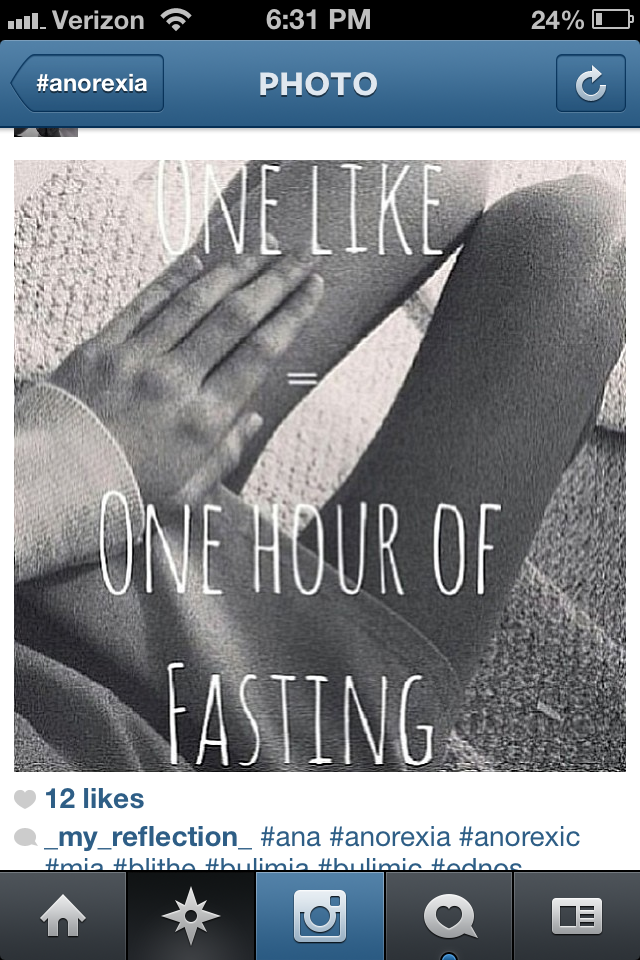

This was not the only picture of its kind.  People would post "one like=one day of not eating". It made me so angry and sad to see so many likes on someones picture and the comments cheering them on. As discussed in my previous posts, Thinspiration is a big part of the pro-ana world (pro anorexia).  People will use images of emaciated bodies as motivation to get thinner.  What Instagram does now is create an entire library of #thinspiration photos that eating disordered individuals are using as "goals". A main concern with so much #thinspiration available, is that it may also create not only unhealthy goals, but create competition between individuals, trying to be the thinnest, or trading ideas on how they got to a certain weight. This is dangerous because the wealth of information that is out there is not just how to recover, but how to maintain the eating disorder, which makes it a lot easier for an individual new to their disease to learn a lot of negative information very quickly. too quickly. 

#anorexia is another support group (both good and bad) that creates a community for those suffering with it.  a mixture of cries for help, pictures liek the one shown above, and quotes saying "nothing taste as good as thin feels". A lot of negative self-talk is most apparent. Its scary that there are so many people out there who are PRO-ANA (pro-anorexia), and they are able to group together to help support each other maintain their eating disorder instead of trying to overcome it. This type of behavior just reinforces their harmful behavior.  Especially since Instagram is not really monitored and parents and family might have a hard time accessing a loved ones IG page, there is no one to tell these Pro-Ana supporters to stop. It is also hard to tell if these Pro-ANA people are also suffering or if this is just another form of bullying; others taking advantage of someones vulnerable state and using it to take control and tell someone else not to eat or tell them that starving themselves is the right thing to do.  I think i spent about an hour just looking through different hashtags of all these pictures and it is hard not to feel heartbroken for these beautiful individuals.  As much as the internet has provided so many resources for eating disorder recovery and recovery groups, negative support is almost as prevalent.  Thank goodness there is a report button, and I think I spent half an hour just reporting...
I thought it was GREAT that instagram has this option. Not because I think reporting the picture will cause a great deal of change, but that might create one less "PRO-ANA" picture for those suffering from an eating disorder. Its sad how engulfed these individuals are by their eating disorder. Another great thing that Instagram has done is to put a warning notice anytime someone tries to search #bulimia #anorexia #eating disorders, etc

This made me so happy to know that there are others out there working towards the cause! The internet and social media is a great way to connect, but we never think people are connecting for these types of reasons.  #Suicide was really depressing as well, and you would think people would be using this to help them out of suicidal ideations, but there are people out there telling them to do follow thru with their suicide. I think in the future of social media, there needs to be more being done about bullying, abusive/offensive statements, and harassment on these sites. A task force or an entire department should be devoted to the cause.  Maybe that could be a prospective venture for me in the future, who knows. lol

What I want everyone to take away from this post, is to be aware of what is out there.  BE aware of what is going on in the world, and as for parents to realize what is out there.  Especially now teenagers have a lot more privacy when it comes to social networking, they can see a lot of things due to the internet and smart phones that was not accessible 10 years ago. This is one of them.  Especially if you have a teen with ED, monitoring all of this is important to make sure they are getting the RIGHT type of support, and not learning tricks of how to hide their eating disorder, or having people support their purging habits.  


to all those who are fighting through their eating disorder, keep fighting, you are strong enough, i believe in you. 
 Pro-Living > Pro-ANA 


Wednesday, May 8, 2013

Back on track!

I am back. Ive been wanting to be back for a long time now but school, work, internship, and my recent aspirations of modeling have taken up any and all time I have left. It has been over a year since I last wrote so I guess I should catch everyone up on my life. Last year I started my Master’s in Clinical Psychology with an Emphasis on Marriage and Family Therapy. My road to being a therapist, working with the eating disorder population, has started! I have had an amazing time so far at Pepperdine University, and I am learning so much, that I am already starting to feel like a real person! I have also started an internship as a “practicing therapist” at a substance abuse center in Compton, CA. It has been a very interesting experience and it feels so amazing being able to practice what I have been learning in school to help better other people’s lives. Its amazing. The reason I did not choose to get an internship at an ED (eating disorders) unit was because I had previous experience at Princeton University Medical Hospital working in the eating disorders unit (which was the most amazing experience), so I wanted to broaden my scope a bit and learn about a different population. I also currently work at Jenny Craig. When I first started working there about a year ago, I didn’t realize how good of a fit it would be for me, but over time I realized that disordered eating has a huge range of how it can affect a person. Overeating and Undereating both are huge issues in today’s society. What they both have in common is that as a “therapist” or “weight loss consultant”, you are trying to help your client obtain a new relationship with food and their body. Both have a hard time with overcoming the control food has had in their lives, and at Jenny Craig I get to help people to establish a new lifestyle towards food and themselves.
 My newest life venture, which is also the primary topic of this post is my new interest in Modeling. I am well aware the stigma of the modeling world and how that effects the media, publications, fashion, etc; and how that has affected society as a whole, especially the female population. Fashion and modeling place a great deal of emphasis towards thin women, and since that is the preference, we see it everywhere. My journey with the modeling world started last year when I auditioned for America’s Next Top Model. This is also where my idea of what type of model I wanted to be had started. During auditions I had met an awesome beautiful girl, who was tall like me, but was not the “stereotypical model”. She was lean, toned, healthy looking, and had curves to her, which most models on the catwalk are missing. As I looked around the group of females I was with, everyone was different shapes and sizes, and it was great to see we had all been in the later rounds of the competition. The girl I had described ended up finishing in the TOP 2! of that season on America’s Next Top Model, and for me that’s when it really dawned on me that the modeling world is starting to change. She did not have to fit the “mold” of a 5’10, 100lbs model, but she still succeeded. A lot of pressure and years of casting those type of models have limited to the runways to size 0s. It seems that the break of 2-4-6-8s are now making their way.
 I have done a lot of thinking about my modeling and how it would affect my career as a therapist working with people with eating disorders, knowing that the industry I am involving myself in has been used as “thinspiration” for thousands of girls who find themselves bent over the toilet because they are trying to strive for thinness. I have thought a lot about it, and realized that the model I want to become is to become a model that should be a inspiration, not a thinspiration. I want to be the model that eats healthy, not depriving herself to fit into a sample size. There is such an obsession with thinness in model world, and I want to enjoy this experience, not suffer through it. I also want to use my modeling to advocate more for ED and positive body image. Basically I want to use this opportunity to be not just a model, but a ROLE model. I know in that, I will succeed. ☺ I will try to update this blog more often with information about ED or just cool articles I think pertain. If you come across any articles feel free to share so I can post it as well. I am so excited to get restarted on this journey! Glad you can join me!

Wednesday, November 2, 2011

How much does a calorie weigh?

For those of you who have taken a science class, you know that a calorie is unit of energy and is not measures by weight necessarily...what I am referring to is how much weight people give to the importance of a calorie. How important is it to them? How much time do people spend looking at calories, counting calories, thinking about calories, and consuming/not consuming calories? You do not have to have an eating disorder for calories to be important. Athletes count calories to make sure they are consuming enough, Dieticians count calories because it is part of their job.etc. There are many reasons why people count calories and why they are important to them, but there are those out there that calories weigh too much of an importance in their life.
The appearance of calories are showing up everywhere. Companies are now putting the calorie content of a soda in big numbers right on the front of the can, just incase one didn’t bother to look at the nutritional facts on the back. Recently in California it became mandated to put nutritional facts on every menu item in a restaurant; which includes mcdonalds to applebees to starbucks. We all know that a Caramel Frap isn’t always the best choice, but now being unable to escape the realization that its 1500 calories might kill the enjoyment for some. I can understand the reason companies and the government choose to make nutritional facts more available. They want people, who normally aren’t aware, to become more educated about what and how much of it they are consuming. For people who did not pay attention before, now they have no choice anytime they go out to eat or get a soda out of the vending machine. Now that people are aware, they can choose to make the "healthier" decisions, maybe apples instead of French fries, or maybe a diet instead of a regular soda. (I put "healthier" in this case in quotations because not all foods that are low in calories are necessarily healthier). For some having the calories on the side of a can is very helpful, for others, it can be an unwelcome reminder of what they are about to put in their bodies
After seeing the good in the appearance of calories I couldn’t help but see what negative effects there can be. For a person with an eating disorder, calorie content can be very triggering. Seeing it now on everything can seem overwhelming for a person with disordered eating. Its in their face more than it has been, and ordering something from a restaurant might not just be a choice of what they are craving that day, but what has the lowest calorie content. During my internship we were instructed to divert sometimes attention if we could see they were focusing on the nutritional facts on their food items. Working in a ED unit, you notice the important that calories have on someone’s emotions. For someone used to counting calories and controlling what does or does not go into their body, finally introducing food that was before “off limits” due to its calorie content, can be very hard. This is a reason why we were instructed not to let them focus on the nutritional facts label. There are various other reasons for this rule, but I can see how someone in the situation might not enjoy the food item as much if they know the details, or it might even prevent the person from wanting it all together. Eventually, we want those recovering from ED to be able to look at calorie content and not have negative feelings towards them, but in the earlier phases of recovery, this might be impossible. So I can see how those with ED might have a problem with the appearance of caloric intake increasingly obvious on food products, but even those without ed can have problems with it as well.
American culture in the past 10 years or so has devoted so much attention on dieting, and most of these diets involve cutting calories. This creates the problem of what one wants and what one “should” have. Yes, we all want to make healthy food choices, but when we don’t, should we be subjected to the burden of knowing the piece of cheesecake we just consumed was half of our recommended daily calorie intake? I don’t think so.
Besides affecting the consumers of these products now, what about the younger generation. The "dietless" generation. The kids who have no idea what a calorie is or what a diet is, how are they going to react to this change? I was at a restaurant the other day, where, there is calorie content next to the menu item, and I overheard a small child asking the mom what the extra numbers were? The mother told the child that it was the amount of calories. The child proceeded to ask what that meant and the mom said something to the effect that its how many points food is; That good foods are less and bad foods are more. As you can probably predict I wanted to go and slap this woman with the menu lol i was not happy. The child is learning at such a young age what is “good” food and what is “bad” food. In my opinion, there is really no such thing. Everything is good in moderation, and as in life, its always important to have a good balance. It makes me concerned that I know this is not the first child to ask their mom the same question, and it worries me to know what other parents are saying as an answer to this question. Are we setting up the child for a healthy perspective of food, or are we setting them of to have a black/white mentality of what they should and should not eat. Should a child ever feel guilty for eating a certain type of food? Of course not. We should be very aware of how we teach out children about food, so they don’t have an unhealthy perspective later on.
Another very important question is, should an adult ever feel guilty for eating a certain type of food? The answer remains the same, no. But for some, that question might be a little harder to answer for some Remember, youre child is like a sponge and their behaviors will reflect youre own. Just because you are educating your child about food in a healthy manner, if you do not follow your own advise your child will see that. For example, youre at a birthday party and cake is being passed around. Your child grabs a piece of cake, but when the mother is offered a slice she makes a comment saying “no thanks, its too many calories, im trying to watch my figure”, the child will see and pay attention to that, and the next time they are offered a slice of cake, it wouldn’t be too surprising they could give the same response. Like they say, monkey see monkey do. And yes the parent might be trying to stay away from food that is high in calories, but it might not be best to demonstrate your concern about calories in front of your child. I am not saying that this child is going to have an eating disorder later in life, its just something that I would be more aware of as a parent who is trying to teach the child to have a positive view of food.
Anyways, going back to my main subject of the more prominent appearance of calories, I think it should have stayed the way it was. Knowledge is power, but I think in this case it is important to look at the cons and not just the pros. Instead of having the calorie content on the can, I think the government should instead use those efforts to teach kids more about things such as the food pyramid. Teach kids the power of whole grains or what foods can make their bones grow strong. I think if the government took this approach instead of just focusing on calories, I think the perspective of food will change and people will stop stressing about calories and instead embrace foods because of how they help your body to function. Just some food for thought… ;)


PS. sorry about my absence from the blog. trying to get back and pumping out more blogs :)

Monday, June 27, 2011

If You Can't Say Something Nice...

I recently started looking into this campaign called #LoveisLouder. Essentially it is an anti-bullying campaign that celebrities are trying to endorse that tries to spread the word to cut down on the negativity in our society. The concept is great, and there is definitely a lesson to be learned. In today's society, the social media has used its influence over society in both positive and negative ways. But, social media also has its downside. They will be the first to BASH someone if they do not follow their rules of 'what not to wear'. Watching E! "Fashion Police" or reading up the daily dose on Perez Hilton's Celebtriy Gossip Website, i am almost disgusted on how brutal they are towards celebrities and their appearances. They are rude, cruel, and straight forward. Usually using someone's fashion mishap or fashion ((faux pa?)) as an excuse for comedy or beratement. They will tear apart a celebrity on every aspect. Starting about how foul their dress is, then to how their body looks, whether they have gained 15 pounds in their thighs or look like skeletons. They continue on to whatever else they chose to attack on. Yea, we can say celebrities are used to this, that they should have to deal with it because its comes with the territory of being famous, but that type of thinking is counterproductive in our society. If we become maladaptive to hearing others getting bashed on their appearance, who is to say we wont think its ok to start doing the same to our friends, or even worse to ourselves?

I will admit to being one of those people. I was almost known for being the person to say something if someone walked by with a ridiculous outfit on. Not to them, but to my friends that would usually be some type of comedic statement but sometimes would just be unnecessarily mean. One year for lent I even gave up talking shit about strangers. Yea i know that is really bad to admit to but that what it was. But, actively working on not saying anything negative about a stranger really showed me that there was no reason to say anything negative about someone you don't know, or even the people you do know, especially when it came to appearances. You never know how much weight your words are worth. While working at the EDU at Princeton, there were so many cases that these girls could remember the first time someone made a comment about their weight/appearance and it happened to have triggered their eating disorder. some people have never been conscious of their body or weight, so when someone says something about it, it can cause people to panic and wonder if somehting is really wrong with their appearance. Not saying that everytime you comment on someones weight they are gunna have an ED, but that words are powerful things, and you should be careful what you do with them. My realization that talking negatively about someone doesn't benefit anyone. It goes to the saying, if you cant say anything nice, don't say anything at all. it does not make the person you're talking about feel better, and it doesn't really benefit you in anyway either. Its a lose lose. Saying something nice is, for the most part, a win win. Telling someone how great they look, will make them smile, and that smile will more than likely make you smile right back. One of the reasons that i want to become a therapist is that I want to make people feel and function better. In my professional life i want to be able to help people work through situations by positive speaking, and in my personal life I should be working on doing the same.

Talking negatively about others is not the only problem, because sometimes the most damaging comments come from ourselves. Its the The days when we tell ourselves we look fat, when we tell ourselves we aren't as attractive, when we don't think we deserve to feel better about ourselves. These comments I have heard from friends, family,and sometimes myself. It happens. We cannot all have good days. But I feel like in our society in particular, the pressure to look a certain way is intense. Thin is the main word that comes to mind. A majority of our society is trying to reach that certain level of thinness, and when we don't achieve it, we feel horrible about ourselves. I was watching Mean Girls other day and it was a good example of this trend. Lindsay Lohan's character Katy was watching The PLastics stand infront of the mirror and pick apart everything they felt was wrong with them. "my nail beds suck", "my shoulders are huge", "i have a huge forehead". and in the background Katy said, "i thought there was only fat and skinny". We have become so much more critical of ourselves, and we alll need to take a step back and accept what we got and what we were given. During my time at the EDU unit, I learned what affirmations were. The therapists would give their patient a phrase to repeat to themselves, maybe 5 times in the morning and 5 at night. They would be stuff that was so simple, "I am beautiful". The point was that at first, they would be saying it, not believing it, but over time they were not just saying it, but telling it to themselves as a fact. I think affirmations don't just need to be used in hospitals but in everyday life. How many times do you look at yourself in the mirror and say, "wow you're beautiful/smart/amazing/gorgous/etc". probably none. but think about it, if you were told everyday you were beautiful, wouldn't that make you smile? lol i think so. POSITIVE THOUGHTS PEOPLE!!

What I was trying to get out of this blog and my message to the masses was that we need to start being nicer as a society. Stop hating on people, stop making fun of others at their expense, and stop making unnecessary comments that does not better anyone. We should all be trying to bring each other up instead of bringing people down. There is a great quote from Marian Anderson, that pretty much sums it up, "As long as you keep a person down, some part of you has to be down there to hold him down, so it means you cannot soar as you otherwise might". Take it as a personal mission to try and eliminate negative talk out of your life. Before you berate someone else or yourself, realize it doesn't help anyone. No one benefits from it. On the other hand, saying something positive is ALWAYS a good thing, and only makes things better.

Wednesday, May 18, 2011

Sweat More, Eat Less

Our society today, as we all know, is overwhelmed with the amount of diet fads, workout plans, and different type of gyms that it literally gives me a headache from trying to understand them all. But throughout my own life, and im sure many others as well, when i think of going on a diet first two things that come to mind are...
1. Work out more
2. Eat Less

For a majority of my older teen/adult life, anytime i attempt to "get in shape" those were the rules. I would like to think I eat pretty healthily. Lots of fruits and veggies, plenty of water, variety of proteins, little to no junkfood. I also have a pretty slender build and have never been overweight. Yet anytime I wanted to start working out, i would cut back my caloric intake because thats how i believed diets worked. Sweat More, Eat Less.
Up until recently I have always hated working out. The thought of it made me miserable. All i could think of was a growling belly and being upset i couldnt run a 6 minute mile. The thought of a gym gave me anxiety. Due to this level of hatred for working out, i hadn't been to a gym in 2+ years. I was afraid of how hte gym made me feel so refused the societal pressure to get a gym membership and work out. But, this past March I decided that for my birthday in june, i wanted to be strong and fit again. Before when i went to the gym it was for everyone else and not for me. It was to fit into the societal norms, to keep up with the celebrities on tv, and unfortunately it was also for the members of the opposite sex. I know a lot of peopel go to the gym for a stress release, but for me it would tend to build more stress than it relieved. So in March, i decided it was for me. there were no pressures to workout and i felt really good about that. I wouldnt get mad that I missed a day, or that i didnt push it at the gym as hard as i should

So i signed up at a RowZone, a Rowing Studio in philadelphia. 12 weeks of unlimited classes to get me started. The first week went great. I was out of shape but it felt good to sweat again, but the 2nd week, my old habits of sweating more and eating less idea of a diet came back. I started cutting back calories here and there. No ranch on my veggies, no desserts, less carbs etc. I felt ok cuttingg back, but when it came to working out at the gym i was drained. I could barely finish the workout. After a conversation with a friend it dawned on me, i can continue to eat what i want, continue to work out, and still will lose weight/build muscle/look fit/feel strong/etc. This sounds liek a simple concept but for most peopel I feel like there is a lot of people who dont see it either.
The media hasnt helped with this concept either. you almost never see a diet being advertised without a workout plan that follows it. And more than likely that diet plan doesnt include carbs. They don't realize that not everyone is trying to lose weight. BUt, since the workout plan typically come with both the diet adn exercise, normally people tend to do both even when its unnecessary. Doing anytype of workout is better than nothing. if you continue eating what you are eating now and and start working out, your body will make changes (losing weight, losing fat, etc) If not trying to lose weight (which i am not trying to do), you are actually able to consume MORE calories than you were eating before. I was talking to my dietician the other day and she even was as bold to tell me that by eating MORE calories might actually cause me to lose weight....? i was shocked. she said that if ur body is working off limited calories, it will hold on to what it needs plus some just in case it needs them for later. But if you are eating a little more than what your body is use to, your body can start getting rid of the extra reserve calories since it knows it doesnt need to hold on to them (aka stored fats) so when you work out, those will be the ones to go first. EPIPHANY! lol

What i am trying to get at in this post is our society's thoughts of a diet is deprivation. Eat less so you can lose more. Although some people, usually those who are trying to fall into a healthy weight range, do need to decrease their caloric intake as well as include working out into their lifestyle, there are the people's whose weight falls in the normal range that dont need to follow this rule that has been set upon us by society. Working out and dieting shouldnt always be to lose weight. The scale can sometimes be our enemy rather than our friend. People focus so much on a goal number, but what I have learned recently is that someones self esteem/bodyimage/confidence should not rest so heavily on a number. What should matter is the image you see in the mirror. For example, i used to be set on the number 130. if i was 130 i convinced myself that i would like the way i looked no matter what. no matter if it was 130lbs of fat or muscle. but then i reached 130. and i didnt like it. my body looked like a teenager. being hispanic, my genetics are made for curves. i wanted curves, i wanted to look like a 22 year old woman. 130 no longer made me happy. luckily this coincidened with the batteries running out on my scale, and i have yet to replace them. Since working out, i have found an entirely new appreciation for my body. i dont even care to think about the scale. if i like the image in front of me, why should a scale matter? Societys pressure to lose weight does not take into consideration that not everybody needs to/wants to/ or should. Be happy with yourself and your body. Even if you are trying to lose weight to get to a HEALTHY weight, try not to focus on a number, whether thats the number on the scale or the size on your jeans, finding a certain level of contentment or happiness at ANY size i feel takes so much pressure off. you dont need a scale to see that youre slimming down and gaining muscle. I enjoy going to the gym now because im not trying to kill myself to lose 5 lbs. im going to the gym to feel strong, to enjoy my body, and to finalyl relieve the other stresses in my life. and i think that THAT is the message that needs to be more in the eyes of the public....hope u enjoyed.

Wednesday, April 27, 2011

Family Matters-The Maudsley approach

Living in such an independent society, we assume people's problems are their own. That person needs to deal with the issue and overcome. People dealing with mental disorders are seen in this light as well. That they need to go to therapy to sort out their issues than magically reemerge in society when they are "fixed". and for most disorders, this is not hte case

One of the papers I wrote in college on the topic of eating disorder had broken this commonly held belief. For patients with eating disorders, whether it is anorexia (AN) or bulimia nervosa (BN), there are many different types of therapy one will have. But, in the past 10 years family behavioral therapy (FBT), has gained recognition and has been widely used in the treatment of eating disorders.

With the research I have seen, although they all vary in their percentages, roughly 80% of people with eating disorders report the onset of the disease before the age of 20. A majority of these patients lie between the ages of 11-19. and it is safe to say a majority of the patients in this age range are still living at home. Therefore, their parents are their source of nutrition. They are the providers of the necessities; food and shelter. This is a main reason why FBT is so successful since it is important to educate the parents about their daughters/sons ED because they are essentially in charge of the food supply. This is not a treatment that blames the parents for the ED but rather, therapists will use the family as one of the strongest resources for helping their child to treat their disorder.


FBT, commonly known as the Maudsley Approach, started in London, and recently came to the states. Brought over by Daniel le Grange, it has proved over and over again to be successful, and here is a brief explanation of what this process entails

The Maudsley approact is done in three different steps

Phase I-Weight Restoration-
This phase focuses on the dangers of malnutrition that hte patient with ED is currently suffering from. (hypothermia, growth hormone changes, cardiac dysfunction, and cognitive and emotional changes). Also during this stage, therapist will usually watch the interaction at meal time between the family and child. They learn the interactions to be able to teach them better ways to help their child to eat, normally. The responsibility of mealtime is given more to the parent than to the adolescent. The therapist will teach the parents how to encourage and support their child during mealtime and how to talk them through a meal. During my experience at UMHP, having to talk someone through a meal is the hardest, but most gratifiying experience. But, after 5 hours of trying to get a patient to finish their ensure, it can get frustrating, and for parents who have to do this everyday, 3 or more times a day, learning how to deal with their frustrations is imperative. Therapist will work with parents to make sure that the parent remains focus. Each meal can be a HUGE obstacle for someone with an eating disorder, and it takes lots of energy on both the parents and the childs part to attempt to finish it. "the Maudsley Approach adheres to the tenet that the adolescent is not to blame for the challenging eating disorder behaviors, but rather that these symptoms are mostly outside of the adolescent’s control". Keeping this in mind, it will help the interaction between the child and parent during meal time, to be a lot more successful.

Phase 2- Returning the power to the patient
now that the patient understands the demand for food consumption that was imposed by their parent, they have gained some weight, and a change in the interaction of the family, phase II can start. This phase basically is when the transfer of power is starting to be given back to the patient. During phase 1, the issue of weight gain was brought up, but now other family issues will be discussed during treatment. It is hard to discuss difficult family issues when the patient is going thru the refeeding process since their mental abilities are not normal. Their moods are often erratic due to starvation, as well as being able to properly process what is going on. Now that their are at a healthier weight, their mood and mental processing is being restored to they are able to more successfull handle complex situations. Also during this stage, the patient will attempt to take power and control over their eating abilities, perhaps going out to the movies with friends, even if the parents are afraid they will choose not to eat, or binge while they are away. The patient is learning how to be in control of their meals, sometimes they succeed and sometimes they fail, but overall, they are trying to learn how to be in control of everyday situations that occur in life.

Phase 3- Establishing healthy adolescent identity
Phase III is initiated when the adolescent is able to maintain weight above 95% of ideal weight on her/his own and self-starvation has abated. I have heard a lot of girl say during their treatment, that their only identity is with their eating disorder. "I am anorexic" or "i am bulimic". Their eating disorder was not only a disorder, but is who they were. This phase teaches them that they are so much more. They teach them a healthy adolescent identity that they might have lost or might have never had due to their eating disorder. Therapist will try and support their personal autonomy, teach them and their parents appropriate personal boundaries, and in a whole, teach the family and patient to live a closer to normal life.

This entire process is a lot harder than just a 3 step program. This is process usually will take up to a hear to get through. And although most patients will recover form their disorder, the relapse rate for eating disorders in general is extremely high, over 50%. Although FBT and other treatments are proven successful at restoring weight gain and abstaining from ED tendencies, there had not been enough being done to find permanent or long term recovery methods for people with ED. Most of the memoirs I have read about ED and people I have spoken to say that they will with with ED for their entire life, but being able to maintain and control it is possible. Although they will live healthier lives without ED tendencies, the thoughts are still there and can be extremely stressful. I hope that with further funding and research that eventually there will be a treatment with longstanding result thats will free people with ED from their ED thoughts.

Thursday, April 7, 2011

Bulimia-quick course

Out of the family of eating disorders, Bulimia is not the most commonly discussed in our society. Most people assume that the reason why people purge (throwup) is because they ate too much and are afraid to gain weight. Therefore, they head to the toliet, stick their finger down their throats, and vomit until their bile or marker comes up
*sidenote: a marker can be characterized as a food someone eats at the beginning of hte meal, something distinguishable in color like nacho cheese doritos, so when they see it come up when they purge they know their stomach is almost emptied.
Although this is the case sometimes, it is not the case all the time. People with bulimia do not only purge because they are afraid to gain weight. They also arent necessarily trying to lose weight. They are just trying to maintain. Also Most people don't know, but even by purging, calories are still being absorbed by the body.
Bulimics are usually triggered by emotions. What I mean by this is that they will become so overwhelmed with emotions (depression, anxiety, anger, etc), they will literally purge their emotions. They have said to feel immediate gratification, but shame and guilt settle in shortly after. This loss of control over their emotions is dealt with in therapy by teaching them how to effectively cope with emotions, and not letting them control them. Sometimes they just dont know any other way to deal with lots of emotions but to purge.
Usually people who purge do so in solidarity, because shame, guilt, and embarassment is a common emotion for bulimics, so avoiding other people knowing is important. Purging can occur once a week or several times a day depending on the severity of the disorder
Bulimia is harder to detect than anorexia since most bulimics tend to be of normal or above normal weight. Anorexics are more detectable due to their emaciated looking bodies. Although bulimia is not as detectable does not mean it is not as damaging as anorexia. Some of the consequences of bulimia are erosion of the esophagus, gerd, weak enamel, electrolyte imbalance, low potassium, heart problems, and a lot others.
Bulimia is not only classified by throwing up. But abusing laxatives, dieuretics, enemas, and over excercising are all considered purging.
There is a lot more i could write about but I hope this will give everyone a better understanding of what characterizes a Bulimic and that one doesnt have to weight 70 lbs to have an eating disorder.